Is a Nobel Prize a team achievement?
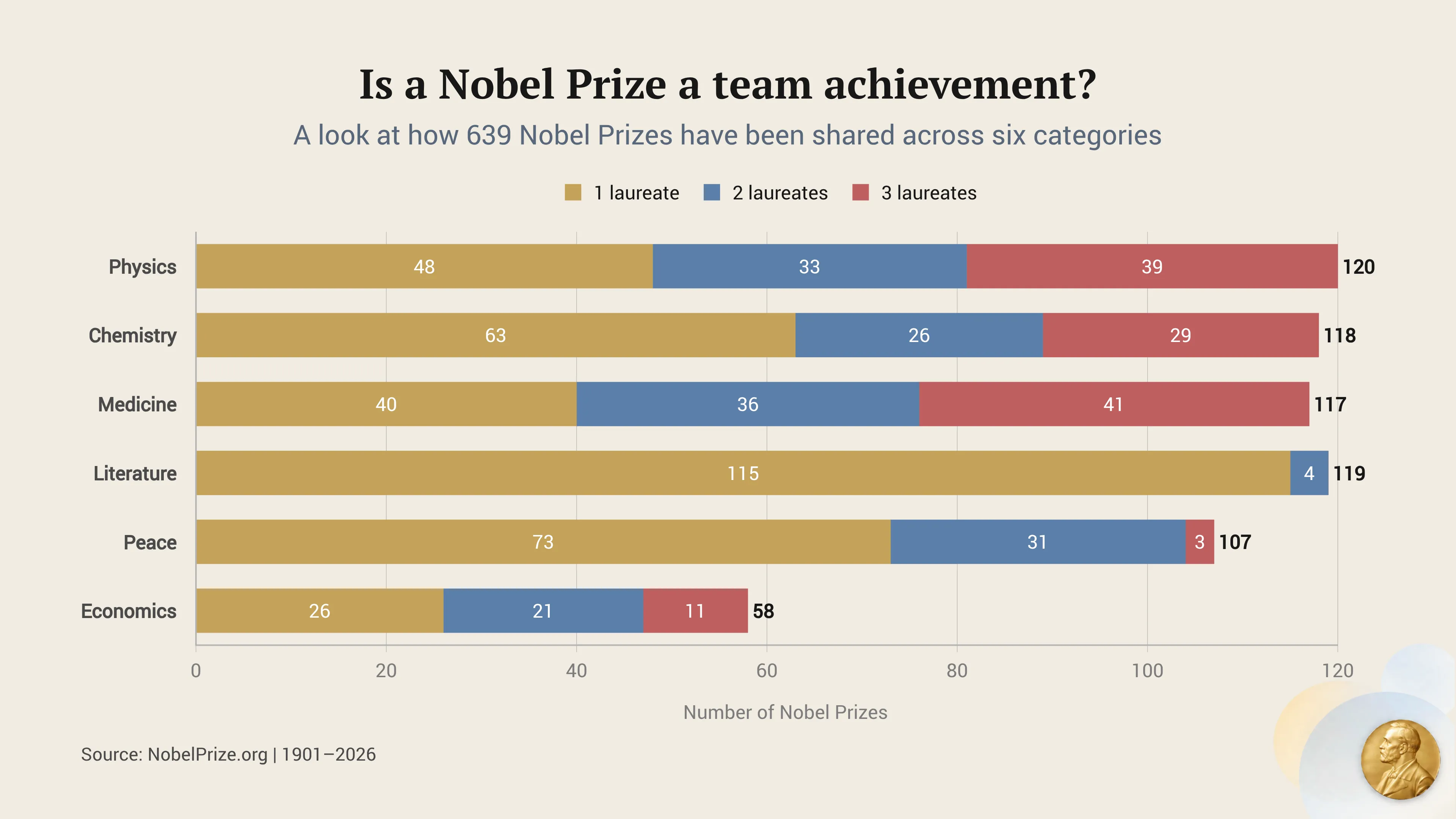
Is a Nobel Prize a Team Achievement? is a stacked bar chart that explores how 639 Nobel Prizes have been distributed among one, two, or three laureates across six categories from 1901 to 2026. The visualization compares Physics, Chemistry, Medicine, Literature, Peace, and Economic Sciences, revealing how the recognition of individual and shared achievements differs across disciplines.
The chart highlights significant differences between categories. Medicine has the highest proportion of shared prizes, with 77 of 117 awards (65.8%) going to two or three laureates. Physics follows with 72 of 120 prizes (60%), while Chemistry shows a more balanced distribution, with 63 prizes awarded to individuals and 55 shared between multiple laureates.
By contrast, Literature stands out as the most individually awarded category, with 115 of 119 prizes (96.6%) going to a single laureate. Peace also favors individual recipients, while Economic Sciences shows a relatively balanced distribution, with 32 of 58 prizes shared among multiple laureates.
By dividing each horizontal bar into three color-coded segments, the stacked bar chart makes it easy to compare both the total number of prizes and how they are distributed within each category. Stacked bar charts are particularly useful for comparing the composition of multiple groups, highlighting differences in proportions, and identifying patterns that might otherwise be difficult to recognize.
Source: NobelPrize.org | 1901–2026
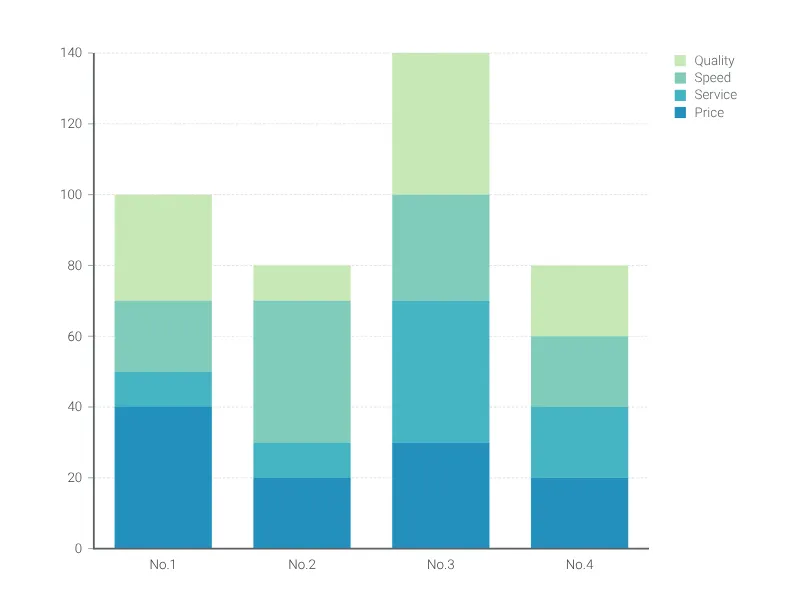
Dies ist ein Beispiel für Vizzlos "Gestapeltes Balkendiagramm"
Heben Sie Teil-zu-Ganzes-Beziehungen von Kategorien hervor und vergleichen Sie verschiedene Gruppen mit diesem gestapelten Balkendiagramm.